
If you run a business, you’ve almost certainly heard terms like antivirus, endpoint protection, and EDR thrown around—often interchangeably. While they all relate to cybersecurity, they are not the same thing, and understanding the differences matters more than ever.
Cyber threats today are quieter, faster, and far more targeted than the viruses of the early 2000s. As a result, traditional antivirus alone is often no longer enough. This is where Endpoint Detection and Response (EDR) steps in.
This article explains:
Antivirus software is the foundation of endpoint security. Its primary purpose is to prevent known malicious software from infecting a device.
Today I installed Huntress EDR for a client in Coombabah. On my way home I got a phone call and a text from Huntress advising me that the site was compromised. The site was locked down awaiting my intervention. Back in the office, I submitted the resolution and got them back online. What's notable about this is that they had been living with this malware in their system for who knows how long.
Traditional antivirus focuses on:
Most antivirus products rely heavily on signature-based detection. This means they compare files and behaviour against a database of known threats. Modern antivirus tools also use:
For everyday threats like:
Antivirus is still very effective.
However, antivirus has some important blind spots:
In short, antivirus is good at stopping the front door being kicked in—but not always great at noticing someone already inside.
If you have signs of virus or malware activity on your PC, contact us about virus removal.

EDR exists because attackers evolved.
Endpoint Detection and Response is designed to continuously monitor endpoint activity, detect suspicious behaviour, and enable rapid investigation and response.
An EDR platform:
EDR doesn’t just ask “Is this file known to be bad?” It asks:
This makes it extremely effective against:
One of EDR’s biggest strengths is visibility.
With EDR, you can see:
This level of insight is critical for:
A client of mine in Worongary got an email from their associate telling them to download Screen Connect. While Screen Connect isn't dangerous of itself, it is often misused. Their associate's PC was infected and this email was a way of transmitting it. When my client downloaded Screen Connect, their EDR (Huntress) shut down all access to the internet. It recognizes the nefarious intent of this app. An anti-virus would never have protected them against this because Screen Connect is not a virus. This incident almost perfectly encapsulates the difference between and anti-virus and an EDR.
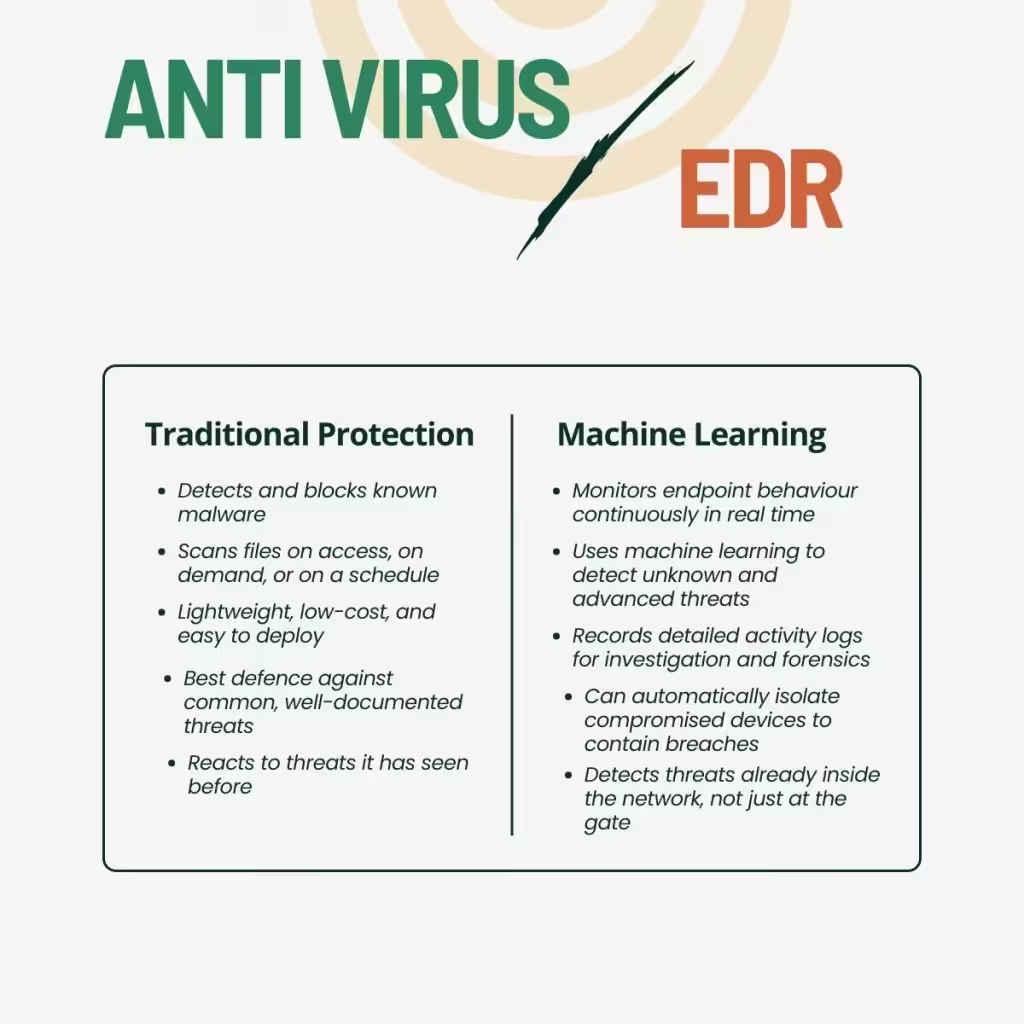
While both protect endpoints, they are built for different jobs.
Antivirus answers:
EDR answers:

This is the part many people miss: EDR does not replace antivirus.
In a modern security stack:
Think of it like this:
Most enterprise-grade EDR platforms actually include next-generation antivirus capabilities, or tightly integrate with them.
Using both provides:
No single tool catches everything. Defence-in-depth is not optional anymore—it’s essential.
For some environments, antivirus may still be appropriate as a standalone solution.
Examples include:
Even then, it should be:
However, once a business relies on:
Antivirus alone starts to become a risk.
EDR is appropriate—and often necessary—when:
If you manage:
You need visibility across all of them.
EDR helps answer:
These questions matter for:
Attackers favour:
EDR dramatically improves your odds of detecting targeted attacks early.
One important consideration: EDR generates a lot of data.
Without trained analysts, alerts can be:
This is why many businesses choose Managed EDR (MDR), where:
For most SMEs, managed EDR provides enterprise-grade protection without needing an internal security team.
Antivirus and EDR are not competitors—they are complementary tools.
In today’s threat landscape:
If you’re unsure what level of protection is right for your environment, the answer depends on your risk profile—not just your size.
At Pogo IT, we help businesses choose the right security stack, not just the most expensive one. Security should fit your operations, your people, and your appetite for risk.
If you’d like to talk through EDR, antivirus, or managed security options, we’re always happy to explain it in plain English.