
For years, “free antivirus” has sounded like a second-rate idea. Okay for casual browsing but not good enough to protect your PC in any serious way.
I disagree, at least in part. That’s why I’m asking, why pay for protection when there are plenty of no-cost options promising to keep your computer safe?
The problem is that the security landscape has changed — and paid antivirus products haven’t kept up in a way that actually benefits users. In many cases, they offer no meaningful advantage over what you already have, while introducing new risks, distractions, and unnecessary complexity.
In this article, we’ll explain why free antivirus software is often a good choice, why Windows Defender already does the job most people expect, and why some well-known “paid” antivirus brands behave in ways that are uncomfortably close to the threats they claim to protect against.
This isn’t an argument against cybersecurity. Nah, it’s the opposite. It’s an argument for using the right tools, not the loudest or most aggressively marketed ones.
If you have signs of virus or malware activity on your PC, contact us about virus removal.
Let’s start with the part that surprises most people.
If you’re running a modern version of Windows, you already have Windows Defender (now called Microsoft Defender Antivirus) installed, enabled, and updating itself automatically.
And here’s the key point:
That includes:
For the average home user or small business, Windows Defender already provides:
In other words, the baseline protection most people are looking for is already there.
Installing a free antivirus on top of Defender rarely improves security — and often makes it worse.
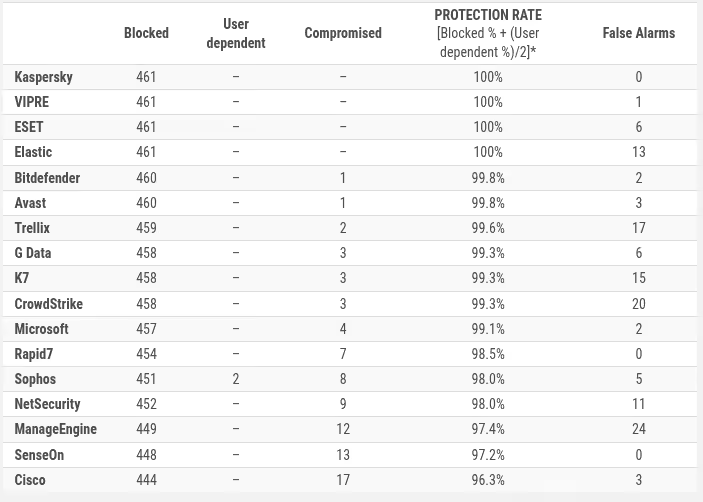
The table above is taken from AV Compared. It shows that Microsoft Defender blocked 99.1% of threats, making it a good option for general protection. Bit Defender did slightly better and has the option of a free version. The free version of Bit Defender gives you all the advantages of the 99.8% detection rate shown above. Likewise, Avast is another great option, though it does tend to upsell a fair bit these days. A lot of people use AVG free, which is owned by Avast. AVG has a lot of upsells also.
A common assumption is that more security software equals more security. Unfortunately, that’s not how it works.
Most paid antivirus products use the same detection techniques as their free cousins. They rely on similar cloud intelligence feeds, and offer no meaningful behavioural or forensic advantage.
In practical terms, this means:
What they do add is:
A lot of what you pay for isn’t anti-virus, it’s VPNs, Ad Blockers, system tools and more. We’ll discuss them below. The main thing to know is, they’re not adding anti-virus to their product when you pay for it, they’re adding other things.
Running multiple security engines at once can cause performance issues, false positives , conflicts during updates, and system instability. Security software operates at a very deep level of the operating system. Adding another tool that does the same job doesn’t double your protection — it doubles the complexity. I've fixed troublesome PCs by removing surplus AV programs
Often, these alerts: Exaggerate minor or irrelevant issues, Warn about problems Defender already handles, Create urgency where none exists.
This isn’t education. It’s fear‑based marketing.
Another major problem with free antivirus products is bundling.
Many now come packaged with:
Most users:
Registry cleaners are a perfect example.
They promise:
In reality:
Microsoft itself does not recommend registry cleaners. Yet they’re still bundled because they look technical and provide a convenient upsell path.
VPNs are another favourite add-on.
A VPN can be useful in specific situations, but bundled antivirus VPNs:
They exist primarily as:
Now let’s talk about something even more problematic.
Many new computers arrive with antivirus products like Norton or McAfee already installed.
These aren’t there because they’re better.
They’re there because:
These products typically:
And here’s the uncomfortable part:
They deliberately reduce your sense of safety as the trial expires.
Pop-ups increase. Warnings escalate. Language becomes more alarming.
This isn’t protection — it’s pressure.
McAfee often bundles with other software if you’re not careful to untick it (I’m looking at you Adobe). This feels a lot like how malware behaves to me.
There’s a reason many IT professionals dislike pre-installed antivirus software.
It often behaves in ways that are eerily similar to the threats it claims to stop:
The pattern looks like this:
If that behaviour came from unknown software, we’d call it suspicious.
When it comes from a well-known brand, we’re expected to accept it.
Another overlooked fact:
You’ve already paid for:
Microsoft has enormous incentives to keep Defender effective:
Defender isn’t an afterthought. It’s a core component of modern Windows.
Replacing it with a free antivirus often means:
Free antivirus software promises peace of mind — but often delivers clutter, noise, and pressure instead.
Paid anti-virus is often just selling you things you don’t need.
For most people:
Sometimes, the safest move is not adding another tool, but trusting the one that’s already doing the job.